(#269)
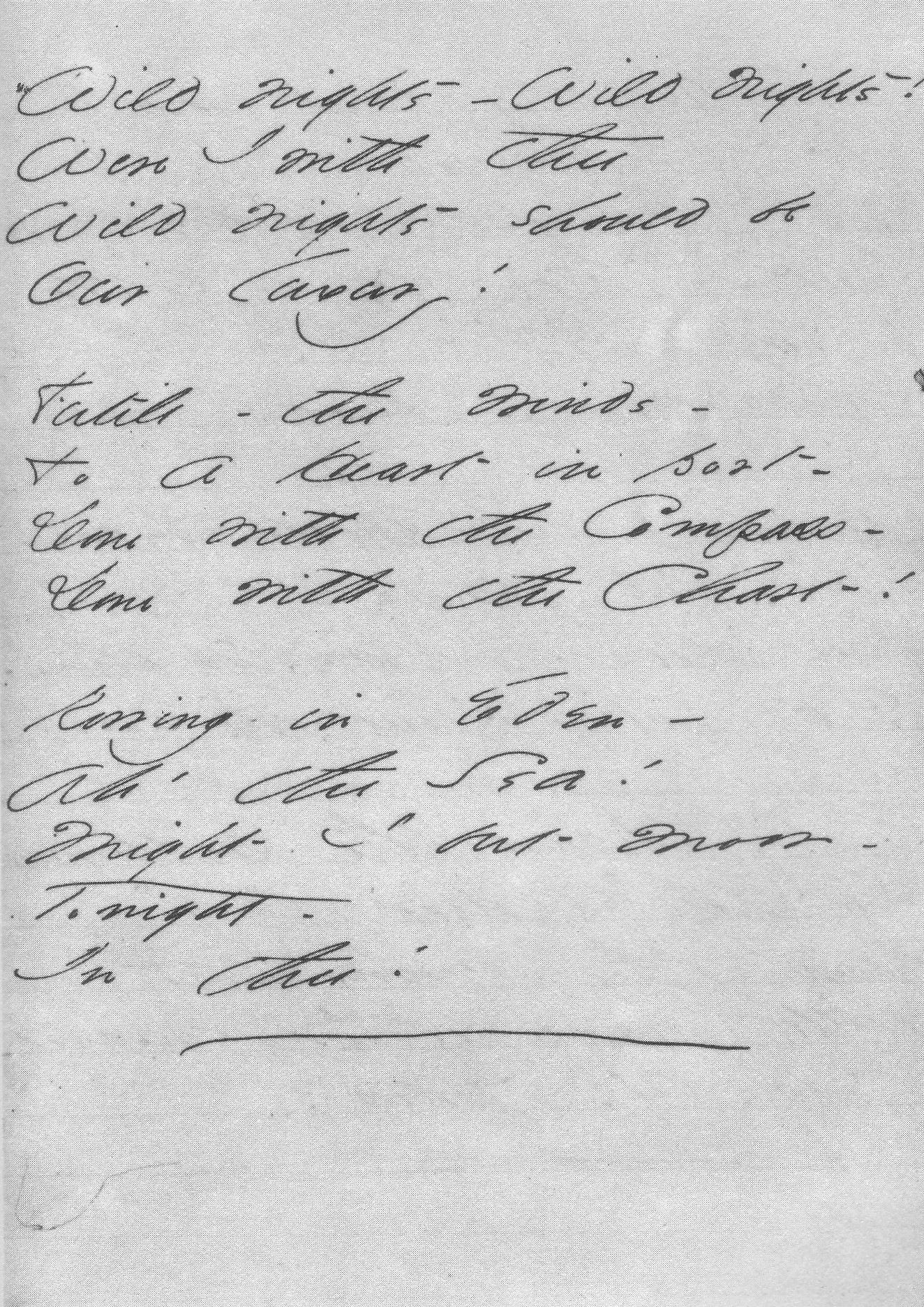
"Wild nights - Wild nights!"
by Emily Dickinson
Wild nights - Wild nights!
Were I with thee
Wild nights should be
Our luxury!
Futile - the winds -
To a Heart in port -
Done with the Compass -
Done with the Chart!
Rowing in Eden -
Ah - the Sea!
Might I but moor - tonight -
In thee!
Write a poem expressing overwhelming, unsettling, intoxicating, electric joy. Express joy with exclamation points and dashes, with unconventional capitalization, with rhymes and half-rhymes, and with an extended metaphor. You might also want to write the poem directly to the source of the joy.
Wednesday, October 1, 2014
Tuesday, September 30, 2014
Poetry Exercise #4: Kaddish
Here's a link to the poem.
Allen Ginsberg's "Kaddish" has the loss of his mother at its center. Write a poem that focuses on the loss of someone or something. The central loss might remind you of other people, places, things that you have lost. Jaclyn W. pointed out that the speaker of the poem reminisces about lots of specific details from the past. We get the names of people, the names of places, vivid descriptions. Try to include lots of very particular memories of who and/or what is no longer with you--no longer part of your material daily life. Then, explore your feelings and thoughts about your memories and about the loss. Danielle B. pointed out feelings of sadness and regret in the poem. I mentioned the sense of release that Ginsberg suggest comes with loss. Explore the feelings and thoughts even if they are complex and contradictory. As always, listen for what rhythms and words sound good together.
Monday, September 29, 2014
Poetry Exercise #3: Cloud in Trousers
by Vladimir Mayakovsky
translated by Peter Bogdanoff
[Part One]
You think malaria makes me delirious?
It happened.
In Odessa it happened.
'I'll come at four,' Maria promised.
Eight.
Nine.
Ten.
Then the evening
turned its back on the windows
and plunged into grim night,
scowling
Decemberish.
At my decrepit back
the candelabras guffawed and whinnied.
You would not recognise me now:
a bulging bulk of sinews,
groaning,
and writhing,
What can such a clod desire?
Though a clod, many things!
The self does not care
whether one is cast of bronze
or the heart has an iron lining.
At night the self only desires
to steep its clangour in softness,
in woman.
And thus,
enormous,
I stood hunched by the window,
and my brow melted the glass.
What will it be: love or no-love?
And what kind of love:
big or minute?
How could a body like this have a big love?
It should be teeny-weeny,
humble, little love;
a love that shies at the hooting of cars,
that adores the bells of horse-trams.
Again and again
nuzzling against the rain,
my face pressed against its pitted face,
I wait,
splashed by the city's thundering surf.
Then midnight, amok with a knife,
caught up,
cut him down
out with him!
The stroke of twelve fell
like a head from a block.
On the windowpanes, grey raindrops
howled together,
piling on a grimace
as though the gargoyles
of Notre Dame were howling.
Damn you!
Isn't that enough?
Screams will soon claw my mouth apart.
Then I heard,
softly,
a nerve leap
like a sick man from his bed.
Then,
barely moving,
at first,
it soon scampered about,
agitated,
distinct.
Now, with a couple more,
it darted about in a desperate dance.
The plaster on the ground floor crashed.
Nerves,
big nerves,
tiny nerves,
many nerves!
galloped madly
till soon
their legs gave way.
But night oozed and oozed through the room
and the eye, weighed down, could not slither out of
the slime.
The doors suddenly banged ta-ra-bang,
as though the hotel's teeth
chattered.
You swept in abruptly
like 'take it or leave it!'
Mauling your suede gloves,
you declared:
'D' you know,
I'm getting married.'
All right, marry then.
So what,
I can take it.
As you see, I'm calm!
Like the pulse
of a corpse.
Do you remember
how you used to talk?
'Jack London,
money,
love,
passion.'
But I saw one thing only:
you, a Gioconda,
had to be stolen!
And you were stolen.
In love, I shall gamble again,
the arch of my brows ablaze.
What of it!
Homeless tramps often find
shelter in a burnt-out house!
You're teasing me now?
'You have fewer emeralds of madness
than a beggar has kopeks!'
But remember!
When they teased Vesuvius,
Pompeii perished!
Hey!
Gentlemen!
Amateurs
of sacrilege,
crime,
and carnage,
have you seen
the terror of terrors
my face
when
I
am absolutely calm?
I feel
my 'I'
is much too small for me.
Stubbornly a body pushes out of me.
Hello!
Who's speaking?
Mamma?
Mamma!
Your son is gloriously ill!
Mamma!
His heart is on fire.
Tell his sisters, Lyuda and Olya,
he has no nook to hide in.
Each word,
each joke,
which his scorching mouth spews,
jumps like a naked prostitute
from a burning brothel.
People sniff
the smell of burnt flesh!
A brigade of men drive up.
A glittering brigade.
In bright helmets.
But no jackboots here!
Tell the firemen
to climb lovingly when a heart's on fire.
Leave it to me.
I'll pump barrels of tears from my eyes.
I'll brace myself against my ribs.
I'll leap out! Out! Out!
They've collapsed.
You can't leap out of a heart!
From the cracks of the lips
upon a smouldering face
a cinder of a kiss rises to leap.
Mamma!
I cannot sing.
In the heart's chapel the choir loft catches fire!
The scorched figurines of words and numbers
scurry from the skull
like children from a flaming building.
Thus fear,
in its effort to grasp at the sky,
lifted high
the flaming arms of the Lusitania.
Into the calm of the apartment
where people quake,
a hundred-eye blaze bursts from the docks.
Moan
into the centuries,
if you can, a last scream: I'm on fire!
Exercise [beginning with ideas from Kenneth Koch and Kate Farrell in Sleeping on the Wing but extended by the Gloucester High students of Creative Writing]
Write a poem that begins with your anger for someone or something and allow that anger to take over the poem as if floating on a flaming stream of consciousness. Fill the poem with vivid, suggestive disturbing, upsetting, aggressive; these images might even surprise you with their fierceness and grossness. (Images of sickness and the body are often particularly effective.) In this poem you can mix long and short lines. Long lines are great for rants. Short lines can be used to pick up the pace and for turning words into punches. Use varied punctuation, including exclamation points and question marks. Keep you ear tuned to cool sounding phrases, like "cloud in trousers."
translated by Peter Bogdanoff
[Part One]
You think malaria makes me delirious?
It happened.
In Odessa it happened.
'I'll come at four,' Maria promised.
Eight.
Nine.
Ten.
Then the evening
turned its back on the windows
and plunged into grim night,
scowling
Decemberish.
At my decrepit back
the candelabras guffawed and whinnied.
You would not recognise me now:
a bulging bulk of sinews,
groaning,
and writhing,
What can such a clod desire?
Though a clod, many things!
The self does not care
whether one is cast of bronze
or the heart has an iron lining.
At night the self only desires
to steep its clangour in softness,
in woman.
And thus,
enormous,
I stood hunched by the window,
and my brow melted the glass.
What will it be: love or no-love?
And what kind of love:
big or minute?
How could a body like this have a big love?
It should be teeny-weeny,
humble, little love;
a love that shies at the hooting of cars,
that adores the bells of horse-trams.
Again and again
nuzzling against the rain,
my face pressed against its pitted face,
I wait,
splashed by the city's thundering surf.
Then midnight, amok with a knife,
caught up,
cut him down
out with him!
The stroke of twelve fell
like a head from a block.
On the windowpanes, grey raindrops
howled together,
piling on a grimace
as though the gargoyles
of Notre Dame were howling.
Damn you!
Isn't that enough?
Screams will soon claw my mouth apart.
Then I heard,
softly,
a nerve leap
like a sick man from his bed.
Then,
barely moving,
at first,
it soon scampered about,
agitated,
distinct.
Now, with a couple more,
it darted about in a desperate dance.
The plaster on the ground floor crashed.
Nerves,
big nerves,
tiny nerves,
many nerves!
galloped madly
till soon
their legs gave way.
But night oozed and oozed through the room
and the eye, weighed down, could not slither out of
the slime.
The doors suddenly banged ta-ra-bang,
as though the hotel's teeth
chattered.
You swept in abruptly
like 'take it or leave it!'
Mauling your suede gloves,
you declared:
'D' you know,
I'm getting married.'
All right, marry then.
So what,
I can take it.
As you see, I'm calm!
Like the pulse
of a corpse.
Do you remember
how you used to talk?
'Jack London,
money,
love,
passion.'
But I saw one thing only:
you, a Gioconda,
had to be stolen!
And you were stolen.
In love, I shall gamble again,
the arch of my brows ablaze.
What of it!
Homeless tramps often find
shelter in a burnt-out house!
You're teasing me now?
'You have fewer emeralds of madness
than a beggar has kopeks!'
But remember!
When they teased Vesuvius,
Pompeii perished!
Hey!
Gentlemen!
Amateurs
of sacrilege,
crime,
and carnage,
have you seen
the terror of terrors
my face
when
I
am absolutely calm?
I feel
my 'I'
is much too small for me.
Stubbornly a body pushes out of me.
Hello!
Who's speaking?
Mamma?
Mamma!
Your son is gloriously ill!
Mamma!
His heart is on fire.
Tell his sisters, Lyuda and Olya,
he has no nook to hide in.
Each word,
each joke,
which his scorching mouth spews,
jumps like a naked prostitute
from a burning brothel.
People sniff
the smell of burnt flesh!
A brigade of men drive up.
A glittering brigade.
In bright helmets.
But no jackboots here!
Tell the firemen
to climb lovingly when a heart's on fire.
Leave it to me.
I'll pump barrels of tears from my eyes.
I'll brace myself against my ribs.
I'll leap out! Out! Out!
They've collapsed.
You can't leap out of a heart!
From the cracks of the lips
upon a smouldering face
a cinder of a kiss rises to leap.
Mamma!
I cannot sing.
In the heart's chapel the choir loft catches fire!
The scorched figurines of words and numbers
scurry from the skull
like children from a flaming building.
Thus fear,
in its effort to grasp at the sky,
lifted high
the flaming arms of the Lusitania.
Into the calm of the apartment
where people quake,
a hundred-eye blaze bursts from the docks.
Moan
into the centuries,
if you can, a last scream: I'm on fire!
Exercise [beginning with ideas from Kenneth Koch and Kate Farrell in Sleeping on the Wing but extended by the Gloucester High students of Creative Writing]
Write a poem that begins with your anger for someone or something and allow that anger to take over the poem as if floating on a flaming stream of consciousness. Fill the poem with vivid, suggestive disturbing, upsetting, aggressive; these images might even surprise you with their fierceness and grossness. (Images of sickness and the body are often particularly effective.) In this poem you can mix long and short lines. Long lines are great for rants. Short lines can be used to pick up the pace and for turning words into punches. Use varied punctuation, including exclamation points and question marks. Keep you ear tuned to cool sounding phrases, like "cloud in trousers."
Friday, September 26, 2014
Poetry Exercise #2: A Supermarket in California
A Supermarket in California
Allen Ginsberg, 1926 - 1997
What thoughts I have of you tonight, Walt Whitman,
for I walked down the sidestreets under the
trees with a headache self-conscious looking
at the full moon.
In my hungry fatigue, and shopping for images, I
went into the neon fruit supermarket, dreaming
of your enumerations!
What peaches and what penumbras! Whole families
shopping at night! Aisles full of husbands!
Wives in the avocados, babies in the tomatoes!--
and you, García Lorca, what were you doing down
by the watermelons? I saw you, Walt Whitman, childless, lonely old grubber,
poking among the meats in the refrigerator and
eyeing the grocery boys.
I heard you asking questions of each: Who killed the
pork chops? What price bananas? Are you my Angel?
I wandered in and out of the brilliant stacks of cans
following you, and followed in my imagination by
the store detective.
We strode down the open corridors together in our solitary
fancy tasting artichokes, possessing every frozen
delicacy, and never passing the cashier. Where are we going, Walt Whitman? The doors close in a
hour. Which way does your beard point tonight?
(I touch your book and dream of our odyssey in the
supermarket and feel absurd.)
Will we walk all night through solitary streets? The
trees add shade to shade, lights out in the houses,
we’ll both be lonely.
Will we stroll dreaming of the lost America of love past
blue automobiles in driveways, home to our silent
cottage?
Ah, dear father, graybeard, lonely old courage-teacher,
what America did you have when Charon quit poling his
ferry and you got out on a smoking bank and stood
watching the boat disappear on the black waters of Lethe?
--Berkeley, 1955
Write a poem with very long lines and lots of alliteration, assonance, and consonance but no rhyme scheme. Write the poem to someone whom you've never met but who has influenced you in some significant way. Pretend you're speaking to them while both of you are in a place that is familiar to you. Include lots of vivid, suggestive imagery. Use the person's name in the poem. Ask them questions.
This exercise is adapted from Sleeping on the Wing, written by Kenneth Koch and Kate Farrell.
Thursday, September 25, 2014
Poetry Exercise #1: This is Just to Say
"Tell all the truth but tell it slant"
Emily Dickinson
In the following William Carlos Williams poem the speaker expresses the truth that we often enjoy things for which we are later compelled to apologize. A complexity of human emotion is that the enjoyment can be sincere and the apology can be sincere despite seeming to contradict each other. Here WCW gets at this complexity not by directly stating it but through a deceptively simple apology note. In other words he finds a "slant" way to tell the "truth."
(This exercise is adapted from Kenneth Koch's Rose, Where Did You Get That Red.)
This Is Just To Say
by William Carlos Williams
I have eaten
the plums
that were in
the icebox
and which
you were probably
saving
for breakfast
Forgive me
they were delicious
so sweet
and so cold
Exercise #1: Write an apology in the form of an unrhymed poem. You (or a fictional speaker) are apologizing even though you are either not entirely sorry or not just sorry but also in some way still pleased with what you did. Write the poem in very short lines (three words or so at most). Use plain and precise language; plums, icebox, breakfast, delicious, sweet, and cold are all precise words in WCW's poem. You might also experiment with line breaks and stanzas. Williams often breaks lines in the middle of phrases and clauses--"in/the icebok" "and which/you were probably/saving..."--but then in the last stanza each each line break comes at the end of a complete phrase. Finally, you might also want to avoid using punctuation especially if it isn't needed.
Emily Dickinson
In the following William Carlos Williams poem the speaker expresses the truth that we often enjoy things for which we are later compelled to apologize. A complexity of human emotion is that the enjoyment can be sincere and the apology can be sincere despite seeming to contradict each other. Here WCW gets at this complexity not by directly stating it but through a deceptively simple apology note. In other words he finds a "slant" way to tell the "truth."
(This exercise is adapted from Kenneth Koch's Rose, Where Did You Get That Red.)
This Is Just To Say
by William Carlos Williams
I have eaten
the plums
that were in
the icebox
and which
you were probably
saving
for breakfast
Forgive me
they were delicious
so sweet
and so cold
Exercise #1: Write an apology in the form of an unrhymed poem. You (or a fictional speaker) are apologizing even though you are either not entirely sorry or not just sorry but also in some way still pleased with what you did. Write the poem in very short lines (three words or so at most). Use plain and precise language; plums, icebox, breakfast, delicious, sweet, and cold are all precise words in WCW's poem. You might also experiment with line breaks and stanzas. Williams often breaks lines in the middle of phrases and clauses--"in/the icebok" "and which/you were probably/saving..."--but then in the last stanza each each line break comes at the end of a complete phrase. Finally, you might also want to avoid using punctuation especially if it isn't needed.
Wednesday, September 24, 2014
Poetry Genre Study: What is Poetry anyway?
What
is Poetry anyway?
A
Mosaic of Responses
Read the following passages about poetry. Pick three comments you agree with strongly, two you disagree with, and
one that you're not sure about. Tell me a little bit about your choices.
1. Ezra Pound,
early twentieth century USAmerican poet
Here’s my paraphrase of what Ez
sez:
It’s useful to think about all
poetry as having three aspects though some poems emphasize one aspect more so
than others:
Phanopoeia
= description = the poem throws
images on the mind
Melopoeia
= musicality = the poem’s sounds
& rhythms evoke emotional correlations
Logopoeia
= mindfulness = the poem
stimulates thought (and feeling) in relation to the poem’s words & word groups
2. W’ei T’ai,
11th century Chinese poet
Whaddya say W’ei?
“Poetry
presents the thing in order to convey the feeling. It should be precise about
the thing and reticent about the feeling, for as soon as the mind responds and
connects with the thing the feeling shows in the words.
“This
is how poetry enters deeply into us. If the poet presents directly feelings
which overwhelm him and keeps nothing back to linger as an aftertaste, he stirs
us superficially; he cannot start the hands and feet involuntarily waving and
tapping in time, far less strengthen morality and refine culture, set heaven
and earth in motion and call up the spirits.”
3. Louis Zukofsky,
twentieth century US
American poet
What’s the news, Lou?
“I'll
tell you. / About my poetics— / music / speech / An integral / Lower
limit speech / Upper limit music.”
(from “A12” a poem)
Like
this:
Music
Speech
4. In a poem called “City Midnight Junk Strains” Allen Ginsberg, twentieth century USAmerican poet, says that Frank O’Hara, another twentieth century USAmerican poet, has a “a common ear for our deep gossip.”
In a
book called Quote Poet Unquote someone
named Liam Rector is credited with
the statement “Poetry is deep gossip.” Sadly neither Ginsberg nor O’Hara
is mentioned by Rector or the book’s editor, Dennis O’Driscoll.
Here are several more
statements about what poetry is from Quote
Poet Unquote book:
5. DAVID GASCOYNE, Stand,
Spring 1992
Poetry
is like a substance, the words stick together as though they were magnetized to
each other.
6. SEAMUS HEANEY, Sunday Independent, 25 September 1994
Poetry
is language in orbit.
7. YVES BONNEFOY, Times Literary Supplement, 12 August
2005
Poetry
is an act by which the relation of words to reality is renewed.
8. MARK DOTY, The Cortland
Review, October 2000
Poetry
is an investigation, not an expression, of what you know.
9. LEONARD COHEN, The Sunday Times
Poetry
is a verdict that others give to language that is charged with music and rhythm
and authority.
10. UMBERTO ECO, The Independent, 6 October 1995
Poetry
is not a matter of feelings, it is a matter of language. It is language which
creates feelings.
11. CHRISTOPHER
MIDDLETON,
PN Review,
March-April 1993
Poetry
is language wrought by feeling and imagination to such a pitch that it enacts
and embodies the thing it says.
12. DAVE SMITH, Local Assays, 1985
Poetry
is a dialect of the language we speak, possessed of metaphorical density, coded
with resonant meaning, engaging us with narrative's pleasures, enhancing and
sustaining our pleasure with enlarged awareness.
13. JOSEPH BRODSKY, The New Yorker, 26 September 1994
Poetry
is a dame with a huge pedigree, and every word comes practically barnacled with
allusions and associations.
14. CAL BEDIENT, Denver Quarterly 39, no.
2, 2004
Poetry
is the eroticization of thought—psychic vitality.
15. MATTHEW HOLLIS, Poetry Book Society Bulletin, Spring
2004
Poetry
is... a kind of leaving of notes for another to find, and a willingness to have
them fall into the wrong hands.
16. CHARLES WRIGHT, Quarter Notes, 1995
Poetry
is language that sounds better and means more.
17. ANNE ROUSE, The Sunday Times, 28 January 2001
Poetry
is about the intensity at the centre of life, and about intricacy of
expression. Without any appreciation of those, people are condemned to
simplistic emotions and crude expressions.
18. FRIEDA HUGHES, The Guardian, 3 October 2001
Poetry
is a way of communicating a vast array of thoughts and feelings by
concentrating them into minimal, or even single, points which describe the
whole.
19. JOHN SIMON, Dreamers of Dreams, 2001
Poetry
is the meeting point of parallel lines—in infinity, but also in the here and
now. It is where the patent and incontrovertible intersects with the ineffable
and incommensurable.
20. DON McKAY, The Toronto
Star, 4 June 2007
Poetry
is language pointing beyond its own capacities.
21. HAROLD BLOOM, The Art of Reading Poetry, 2006
Poetry
essentially is figurative language, concentrated so that its form is both
expressive and evocative.
22. PETER FALLON, The Poetry Paper, no. 3, 2006
A poem
is words at work, on us and for us.
23. ÁGNES NEMES NAGY, A Hungarian Perspective, 1998
A poem
is partly grace, partly discovery, and partly a struggle to squeeze out a
little bit more, to conquer another foot of territory from the unconscious.
24. P.J. KAVANAGH, BBC Radio 3, December 1990
A poem
is an attempt to find the music in the words describing an intuition.
25. NUALA NÍ
DHOMHNAILL,
RTÉ I television, July 1995
A poem
is a smuggling of something back from the otherworld, a prime bit of
shoplifting where you get something out the door before the buzzer goes off.
26. WILLIAM H. GASS, The Georgia Review, Spring 2004
A poem
is like a ghost seeking substantiality, a soul in search of body more appealing
than the bare bones mere verses rattle.
27. CAROL ANN DUFFY, Out of Fashion, 2004
A
poem... is the attire of feeling: the literary form where words seem
tailor-made for memory or desire.
28. JAMIE McKENDRICK, The South Bank Show, October 1994
Every
poem is an answer to the question what poetry is for.
29. After I
thought I’d finished this collection I found this statement from Audre Lorde’s Power, Oppression and the Politics of Culture: a lesbian/feminist
perspective:
“For
women, then, poetry is not a luxury. It is a vital necessity of our existence.
It forms the quality of the light within which we predicate our hopes and
dreams toward survival and change, first made into language, then into idea,
then into more tangible action.”
30. &, finally, this statement on
poetry by Paul Celan* is part of my
friend Pierre Joris’s email signature:
“The poem is the detour from you
to you; it is the route. It is also
the
route of language toward
itself,
its becoming visible and
mortal: wherewith the poem
becomes the raison d’être of
language.”
Celan was a
German-speaking Jew in Eastern Europe. He
survived World War II. His town in a place called Burkovina that was then
Romanian and now Ukrainian was first occupied by the Soviets and later by the
Nazis. He spent much of the war in Nazi-run labor camp. His parents were handed
over to the Germans and killed.
Tuesday, September 23, 2014
Fiction Revision and Reflection
Reflecting on Fiction Final Drafts
2. At the end of your fiction write the word "Reflection". Then, write our your revision process: everything you did with your story from the day of your workshop until you finished revising your story. Be specific.
3. Then, do some metacognition. Think about your thinking. Why did you make the decisions you did? What helped? What didn't help? What are you still unsure about?
All of the above is due Wednesday, September 24 for people who had a workshop last week and Thursday, September 25 for people who had a workshop this week.
4. Read the fiction writing advice found here. Pick three comments you agree with strongly, two you disagree with, and one that you're not sure about. Tell me a little bit about your choices.
#4 is due by Thursday, September 25 for everyone.
Subscribe to:
Posts (Atom)